
Vietnam's Coffee Regions
Vietnamese coffee is not one coffee. The cool northern mountains, the hills around Đà Lạt and the red soil of the Central Highlands each grow something different. Here is where our three coffees come from, and what the place does to the cup.
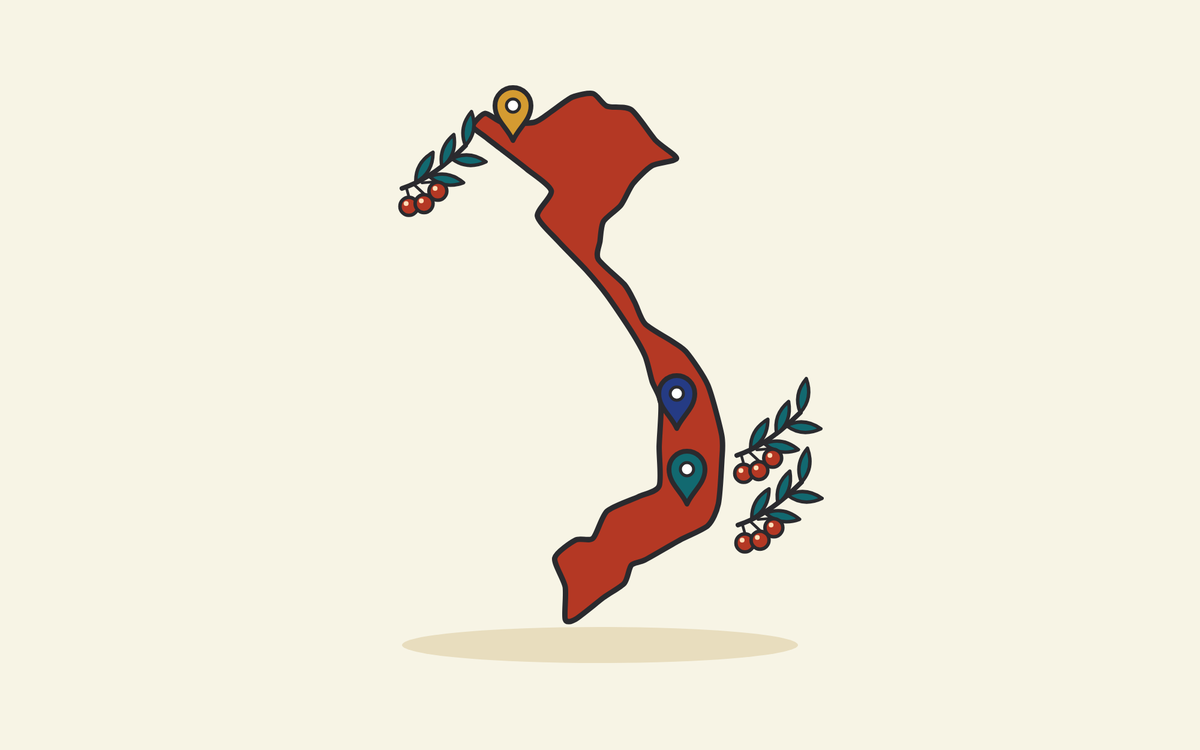
Short answer: most Vietnamese coffee is Robusta from the Central Highlands, around Buôn Ma Thuột. Higher up, around Đà Lạt, farms grow both Robusta and Arabica. In the cool far north, Lai Châu grows Arabica. Our coffees come from all three: Saigon Drip from Buôn Ma Thuột, Da Lat Dawn from Cầu Đất and Hanoi Haze from Lai Châu.
Three Regions, Three Coffees
The capital of Đắk Lắk province in the Central Highlands, often called Vietnam's coffee capital. Warm, low hills and red basalt soil: Robusta country. Our Saigon Drip grows here at 400–500 m.
Hills just outside Đà Lạt in Lâm Đồng province, known for tea and coffee. Cooler and higher, so both Robusta and Arabica grow. Our Da Lat Dawn comes from 700–800 m.
A mountain province in the far north-west, near the Chinese border. Cool and high, the conditions Arabica likes. Our Hanoi Haze grows at 1200–1300 m.
Region by Region
| Region | Altitude | Bean | Process | In the cup |
|---|---|---|---|---|
| Buôn Ma Thuột · Saigon Drip | 400–500 m | 100% Robusta | Washed | Cocoa, toasted grain, nutty. The strongest |
| Cầu Đất · Da Lat Dawn | 700–800 m | 60% Robusta, 40% Arabica | Honey | Dark cocoa, toasted grain, nutty sweetness |
| Lai Châu · Hanoi Haze | 1200–1300 m | 100% Arabica | Washed | Floral, citrus and stone fruit, light nutty sweetness |
Named after cities, grown in the hills
Our coffees carry the names of the places that shaped how Vietnam drinks coffee: Saigon's iced milk coffee, Đà Lạt's cool mornings, Hanoi's slow cafés. The beans come from the farming regions listed above. We name both, because "Vietnam" on a bag tells you very little.
What the Place Does to the Cup
Higher and cooler means slower ripening and more aromatic, brighter coffee. That is why Arabica grows up in Lai Châu and Robusta in the warmer, lower Central Highlands.
Robusta brings body, cocoa and about twice the caffeine of Arabica. Arabica brings acidity and fruit. The share decides the character more than anything else.
Washed coffee has its fruit removed before drying: cleaner and brighter. Honey process leaves some of the sticky fruit layer on while it dries: sweeter and rounder.
Taste all three regions
The gift set: 100 g each of Hanoi Haze, Da Lat Dawn and Saigon Drip, plus a PHINOI phin filter, in a gift box. CHF 43.00.
FAQ
In the Central Highlands (Tây Nguyên), especially Đắk Lắk province around Buôn Ma Thuột. Most of it is Robusta. Smaller amounts of Arabica come from around Đà Lạt and from the northern mountains.
Robusta thrives in the warm, lower hills of the Central Highlands, where most Vietnamese coffee is farmed. Vietnam is the world's largest Robusta producer. Arabica needs the cooler, higher land of the north and around Đà Lạt.
Yes, a small share of the harvest, mainly in the northern mountains and around Đà Lạt. Our Hanoi Haze is 100% Arabica from Lai Châu.
The skin of the coffee cherry is removed but some of the sticky fruit layer is left on the bean while it dries. It has nothing to do with honey. It usually gives a sweeter, rounder cup. Da Lat Dawn is honey-processed.
Yes. We ship all three from Winterthur anywhere in Switzerland with Swiss Post, free on orders over CHF 60. More options in our guide: where to buy Vietnamese coffee in Switzerland.